
Executive Summary
Lexter was an early-stage legal recruiting company with a sharp founder, a real insight about a sleepy industry, and a product that most firms agreed was better than what they had. The problem was that “better” doesn’t move fast in the world of legal. Adoption was slow, deals stalled, and our core offering - while novel and useful - wasn’t going to hit the growth we needed.
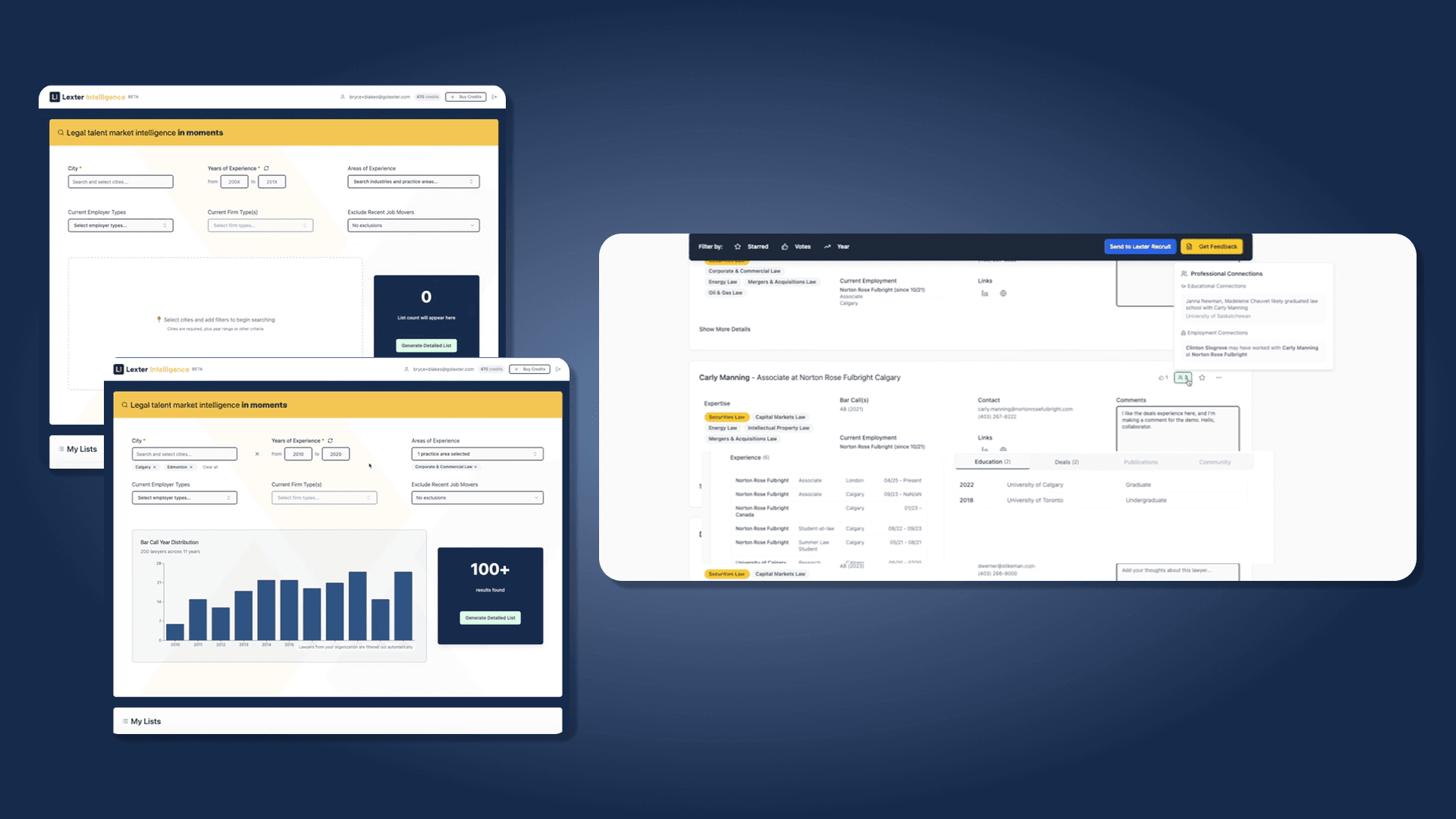
As VP Product + Growth, I spent a lot of time in discovery and kept hearing the same thing from different angles: firms needed high-quality talent intelligence long before they were ready to hire a recruiter. So I proposed, prototyped, and led the launch of a second product - Lexter Intelligence - a self-serve platform that let firms build deep, filterable, collaborative lawyer target lists from our national dataset. (Side note: I also designed the database structure for this level of future scalability - success).
Within weeks of launch, we were getting into the offices of clients that had previously ignored us, and revenue booked from the Toronto office of the largest law firm in the world - asking to pay for access to what was still effectively a prototype.
Business Context & Problem
Legal is an industry that is heavily, heavily over-incentivized to play it safe. One example that stuck with me: a COO at one of Canada’s more “innovative” firms told me they had sent their office manager to lunch with five other firms’ office managers to decide whether mail should be delivered to desks once a day or twice a day. That’s the decision velocity and risk paralysis we were selling into.
Our core product, Lexter Recruit, legitimately solved some of the most annoying problems in legal hiring. Most people we met agreed and liked the idea - but not enough to be the ones to champion a startup internally. We had a go-to-market problem dressed up as a sales problem, and adding more sales effort wasn’t going to fix it.
What we actually needed was a lower-friction way in - something that let firms get real value from us before committing to change their hiring process. Something they could tack on to make Lexter - the brand - part of their workflow, without requiring a long purchasing approval process.
Discovery and Insight
I spent a lot of time talking to lawyers, firm leadership, COOs, and internal HR teams. Not structured “we need answers” interviews, but the kind of conversations where you keep asking “and then what do you do?” or “tell me more” until something interesting falls out. (Big thanks to The Mom Test for making that second nature.)
Two initial patterns kept surfacing:
- Firms were paying full-time employees serious money to manually build lawyer lists before a search had even started - mostly via Google and copy-paste from competitor bios. They considered this the ‘cost of doing business’ but agreed it was a waste.
- A whole segment of firms didn’t want legal recruiters at all. Their partners wanted to do their own headhunting; they just needed to know who was actually out there that fit the bill, which was more difficult outside of their current cities and networks.
Then, a third insight landed that reframed the opportunity. These lists weren’t just used for hiring. They were used for COO-level decisions - whether to let a partner go, whether to keep an articling student, how exposed the firm was to a departure. You can’t lose a partner easily if nobody in the country could replace them.
That shifted the problem from “help firms hire faster” to “help firms see the market clearly enough to make bigger decisions.” That’s a very different product.
The Bet
The hypothesis was straightforward:
- There’s a real job-to-be-done around legal talent intelligence that’s separate from recruiting.
- A self-serve product could reach firms and titles we’d never sell Recruit to.
- It would also give our existing sales motion a softer, earlier entry point.
I built a weekend prototype, put together a simple pitch, and brought it to the team Monday morning. The founder - who, like most founders, had strong opinions and plenty of his own vision to defend - was in. That mattered. A lot of this job is being able to bring founders clear, evidence-backed ideas without making them feel steamrolled. The deal we struck across the Lexter years was consistent: he brought the capital, the ambition, and the chaos; I turned that into structured forward motion. Lexter Intelligence was a clean example of that working.
Product Build and Launch
I built v1 in Lovable to validate the core interactions, then worked with our engineering team to stand up the proper API structure and production front-end.
What shipped in v1:
- Account and firm-office structure so users never saw lawyers from their own firm or recent employers
- Filters for region (the first Canada-wide legal search of this depth), seniority, practice area, industry, firm vs. in-house experience, and move/promotion recency
- Tiered list views with quick links to firm bios and LinkedIn, and lawyer-level comments for teammates
- Secure share links so stakeholders could review, comment, and vote without logging in
- A Connections feature that quietly became our wow moment - when a user built a list, the system surfaced how each target lawyer was connected to people already inside the firm, through past employment and education. Usually within 30 seconds of the list loading.
Tools and systems used:
- Lovable for rapid prototyping (I now tend towards Claude to lower costs)
- A combination of Supabase and a Postgres-based API setup in DigitalOcean
- Clerk for an authentication system that tied Recruit logins and user data to Intelligence
Outcomes
Lexter Intelligence changed what we could sell, who we could sell to, and how fast conversations moved.
Commercial and GTM outcomes:
- First revenue bookings for Lexter
- Clear validation that buyers wanted different things: some wanted Recruit, some only wanted Intelligence, and some wanted both. That let us stop trying to sell one answer to a segmented market.
- Within about a month of launch, and on only our third pitch, the Toronto office of the largest law firm in the world asked to become our first paid subscriber on a six-month contract.
Product outcomes:
- Replaced a manual, expensive, low-quality internal workflow with a structured self-serve experience
- Gave firms the connections and market visibility they were previously hand-building over days
- Turned a passive brochure-style sales conversation into a live demo where prospects could see themselves using it
Leadership and Skills Demonstrated
Hard skills
- User research and synthesis - turning messy qualitative signal into a productizable, monetizable problem
- Rapid prototyping - getting from insight to testable product fast enough to move the business
- Product and API collaboration with engineering - making real, defensible scope decisions with the dev team, not just throwing designs over a wall
- GTM-product linkage — packaging and positioning the product so different buyer types got the right entry point
Soft skills
- Working with founders - keeping a strong-willed visionary aligned without blunting his vision, and getting buy-in for a bet he didn’t originate
- Customer empathy that translates to growth - sales likes working with me because customers opened up in my conversations, and those conversations fed the roadmap
- Execution ownership - I saw an uncovered problem, got curious, and built the thing end to end with light dev support. Nobody asked for it. Everyone was glad it existed.
- Turning chaos into direction - probably the single most consistent piece of feedback I’ve gotten across every role I’ve held is my ability to de-chaos the chaos
What I Learned
- In conservative markets, those who best understand their customers’ problems and incentives are best positioned to be one of the few solutions that gets accepted
- The best discovery doesn’t just prioritize the roadmap - it occasionally changes what product you’re building.
- In early-stage, the product leader has to be credible in strategy and willing to build the prototype themselves. Both. Not either.
- If I can debug a CORS error at midnight on a weekend, I can probably figure out most things I put my mind to. Even if I still don’t fully know what CORS means. Something about permissions.
Why This Matters Across Stages
This is clearly a 0-1 / 1-A story - ambiguity, net-new product creation, building with almost no scaffolding around me. But the operating principles underneath it hold up at later stages too:
- Lead with evidence, not opinion - while recognizing that you’re working with real humans
- Tie product decisions to the commercial reality of the business
- Keep founders and executives aligned without losing the customer’s voice
- Move fast without skipping the parts that make the output durable
That’s how I operated at Lexter with 15 people. It’s also how I’d operate on a larger product org in a more structured company. I believe the skills that made this moment successful are what make all product leaders successful: curiosity and leaving one’s ego at the door, rigorous user research, getting stakeholder buy-in, rapid prototyping, working with developers to solve problems, and being willing to bet on yourself and push across the finish line.